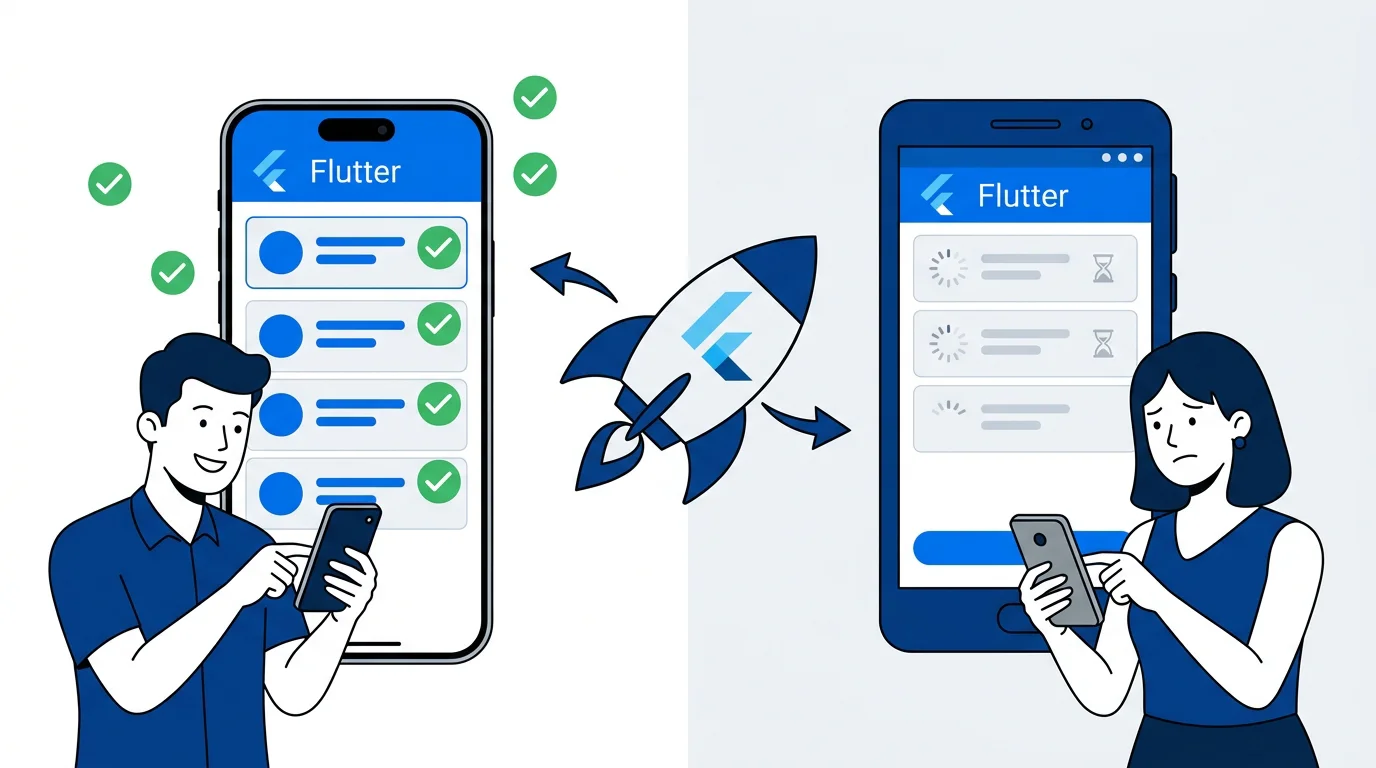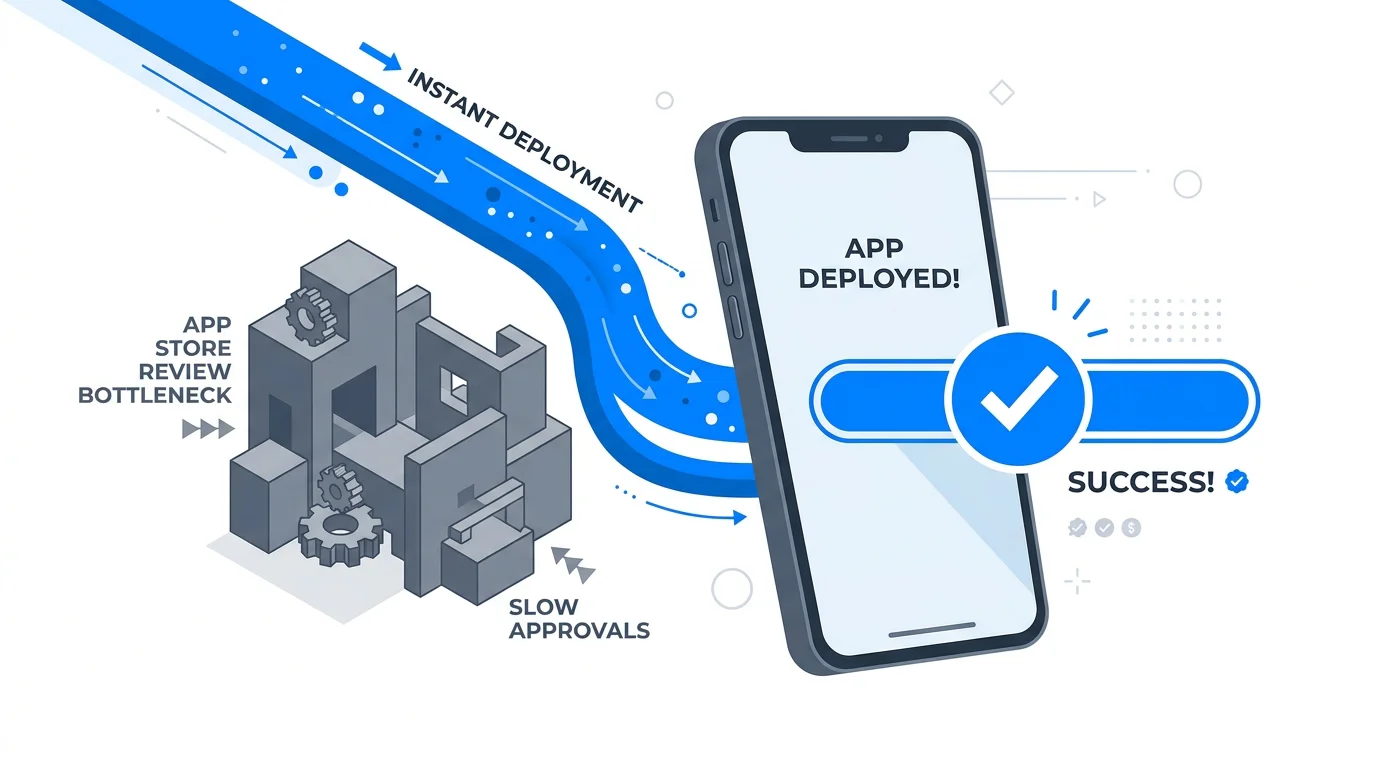
App store review processes are a massive liability when a critical bug hits production. Waiting three days for Apple or Google to approve a one-line hotfix costs revenue, breaks user workflows, and destroys trust. Engineering teams demand agile workflows, immediate bug fixes, and continuous feature rollouts. These modern development practices clash directly with the archaic, gatekept deployment cycles of native app stores.
Over-the-Air (OTA) updates provide the obvious technical escape hatch. They allow developers to push code changes directly to user devices, entirely bypassing the app store review queue.
If you come from the React Native or Cordova ecosystems, you already know the standard playbook: you integrate CodePush, swap out your JavaScript bundles, and move on. But Flutter requires a radically different approach. Flutter’s compilation model fundamentally breaks the CodePush paradigm.
This guide will break down exactly why CodePush fails in a Flutter environment, examine the mechanics of Ahead-of-Time (AOT) compilation, and provide a deep technical breakdown of Shorebird the industry standard for executing safe, diff-based Flutter Over-the-Air Updates in production.
The CodePush Illusion: Why It Fails for Flutter
Bring up OTA updates in a cross-platform engineering meeting, and someone will inevitably mention Microsoft’s CodePush. CodePush is a highly effective service engineered specifically for React Native and Cordova.
It functions by delivering updated JavaScript bundles and image assets directly to the client device. The mobile application, which houses a JavaScript runtime environment, simply downloads the new .js file, reloads its internal state, and executes the fresh logic.
CodePush for Flutter does not exist, and from an architectural standpoint, it never will.
You must understand the compilation differences between the frameworks. Flutter does not ship a runtime interpreter, nor does it execute a dynamic text-based script on the client's device. Instead, Flutter compiles your Dart code down to native ARM or x64 machine code via Ahead-of-Time (AOT) compilation.
This distinction breaks the CodePush model for two distinct reasons:
- You cannot swap a JS bundle: There is no JavaScript bundle to replace. Your application logic is baked into a highly optimized native binary.
- OS Security Restrictions: Modern operating systems iOS in particular enforce strict memory protection policies like Write XOR Execute (W^X). This security mechanism dictates that memory pages can be writable or executable, but never both simultaneously. You cannot simply download a new raw executable binary from the internet and run it dynamically. The operating system will immediately terminate the application to prevent malicious code injection.
To achieve OTA updates in Flutter, engineering teams needed a system capable of updating compiled native binaries safely, efficiently, and within the strict sandboxed boundaries of iOS and Android.
Enter Shorebird: The Diff-Based Architecture
Shorebird was engineered by members of the original Flutter team specifically to solve the AOT update problem. It does not attempt to mimic CodePush’s bundle-swapping behavior. Instead, Shorebird operates closer to the metal. It patches the compiled native instructions of your production Flutter application.
Shorebird provides atomic, diff-based updates for Dart code. It requires a fundamental shift in how your application is built and executed.
1. Intercepting the Flutter Engine
A standard Flutter application ships with the default Flutter engine, which simply boots up and executes your Dart AOT snapshot. Shorebird intercepts this process.
When you integrate the Shorebird SDK, your build pipeline actually swaps the standard Flutter engine for a customized, Shorebird-enabled fork. This modified engine contains the necessary logic to safely intercept the boot sequence, check local storage for verified code patches, and inject those patches into the running environment before the Dart isolate initializes.
2. The Dart AOT Snapshot Mechanics
When you execute a release build in Flutter, the compiler generates an AOT snapshot. This is a highly optimized binary representation of your entire application's Dart code. The Shorebird CLI is built to parse, analyze, and manipulate this specific snapshot format.
3. Generating the Binary Diff
Bandwidth and speed matter when pushing updates to millions of devices on spotty cellular networks. You cannot force users to download a 50MB binary every time you fix a typo.
Shorebird handles this through sophisticated binary diffing. When you push a new release, the Shorebird cloud infrastructure compares your new AOT snapshot against the previously deployed baseline snapshot. It calculates the exact byte-level differences and generates a microscopic patch file often measuring only a few kilobytes.
4. Client-Side Patch Execution
The embedded Shorebird SDK runs a background thread in your application. It pings the Shorebird servers to check the current patch version against the local baseline release.
If a new patch exists, the payload is downloaded. Shorebird does not attempt to hot-swap the code while the user is actively tapping buttons. The patch is staged in local secure storage. Upon the next application restart, the Shorebird-enabled engine detects the staged patch and applies the new machine instructions directly over the base AOT snapshot in memory.
Production Workflows and CI/CD Integration
Implementing Shorebird Flutter architecture completely changes how your DevOps pipeline handles releases. You must separate your deployment strategy into two distinct categories: Releases and Patches.
The "Release" Paradigm
A "Release" is a full base binary (.ipa or .aab) submitted to the App Store or Google Play.
Instead of running the standard flutter build ipa, your CI/CD pipeline executes: shorebird release ios
This command compiles the app using the custom Shorebird engine, registers the baseline AOT snapshot hash with the Shorebird cloud, and outputs the binary for you to submit to Apple or Google.
The "Patch" Paradigm
A "Patch" is a subsequent OTA update applied on top of an existing Release.
When you fix a bug in your Dart code, you do not submit a new build to the App Stores. Instead, your CI/CD pipeline executes: shorebird patch ios
Shorebird analyzes the new code against the registered base Release, generates the kilobyte-sized diff, and instantly deploys it to your global user base.
Navigating the Constraints: What You Cannot Update
Shorebird is powerful, but it operates within strict boundaries. It modifies the Dart AOT snapshot. It does not have blanket access to rewrite your entire application package.
You must cut a full new App Store Release if you change any of the following:
- Native Platform Code: Any modifications to Swift, Objective-C, Kotlin, or Java files require a full store submission.
- Native Dependencies: If you update a package in your
pubspec.yamlthat relies on underlying native iOS/Android SDKs (e.g., updating a camera plugin or a payment gateway SDK), you cannot patch it. Shorebird cannot update the native code linked by those plugins. - Flutter Version Upgrades: Upgrading your project from Flutter 3.19 to Flutter 3.22 changes the underlying Flutter engine itself. You cannot patch an engine upgrade; it requires a hard release.
- Asset Changes: Depending on the implementation and current tooling versions, sweeping changes to massive local assets often require careful handling or a full release to ensure optimal user experience.
Infrastructure Time-Sinks and the Stacklyn Labs Advantage
Architecting a mobile application for enterprise scale is brutal. Implementing Shorebird into your CI/CD pipeline is just step one. Modern production applications also require bulletproof state management, offline-first data persistence, robust local database syncing via CRDTs (Conflict-free Replicated Data Types), and secure authentication layers.
Building these systems from scratch is a massive time-sink. Engineering teams easily burn 300 to 500 hours simply wiring up infrastructure before they ever ship a single business feature.
This is exactly why we build production-ready mobile architectures at Stacklyn Labs.
We engineer premium Flutter templates and SaaS-in-a-Box bundles designed specifically for development agencies and high-velocity teams. By utilizing a Stacklyn Labs architecture, you completely bypass the infrastructure phase. You get offline-first data syncing, advanced state management, and OTA-ready deployment pipelines pre-configured on day one. Stop reinventing the wheel and start shipping scalable software months ahead of schedule.
Shorebird only helps once a release is live, though. Getting that first release signed, correctly identified and store-ready is the step many teams underestimate when they start from a purchased template. If you would rather hand it off, our app reskinning service rebrands the template, sets the package name, signs it and hands back store-ready builds.
App Store Compliance and Safety
Any discussion about dynamic code execution inevitably leads to concerns about Apple's App Store Review Guidelines. Will your app get banned? If your app started life as a purchased template, there is an earlier review question to settle first, covered in our guide to App Store 4.2.6 template rejections: who submits the app, and whether it looks too much like the original.
The rule that matters here sits in the Apple Developer Program License Agreement, not the App Review Guidelines. Its section 3.3.1(B) allows interpreted code to be downloaded to an app only under set conditions, and the first is that the code does not change the app's primary purpose. App Review Guideline 2.5.2 draws the same line from the review side: an app may not download or execute code that introduces or changes its features or functionality. Shorebird's FAQ explains how its iOS patches run through an interpreter to stay inside that rule.
Deploying a hotfix for a broken checkout button is perfectly legal. Pushing an entirely new UI to bypass Apple's payment systems, or transforming a weather app into a gambling platform via a Shorebird patch, will result in immediate developer account termination.
Furthermore, Shorebird guarantees atomic updates. A patch either downloads and applies flawlessly in its entirety, or it fails and is discarded. If a user loses cellular connection halfway through a patch download, the application simply boots using the last known good state. It will not crash or brick the user's device. If you accidentally deploy a patch that introduces a new bug, Shorebird’s dashboard allows you to execute an instant rollback, reverting all users to the previous stable state on their next app launch.
The Pragmatic Takeaway
The era of waiting for external gatekeepers to approve your typo fixes is over. The technology exists to treat mobile deployments with the same agility as web deployments.
Rethink your deployment strategy. Separate your native architecture changes from your Dart logic updates. Implement a reliable Flutter CodePush alternative like Shorebird into your CI/CD pipelines, and reclaim total control over your production environment.
References & Further Reading
- Shorebird Official Documentation
- Shorebird Blog: Why Shorebird Exists
- Shorebird Blog: How Shorebird Works
- Microsoft Learn: App Center CodePush Overview

Written by Stacklyn Labs
Stacklyn Labs is a small studio publishing offline-first Flutter templates on CodeCanyon and Codester since 2025, and building custom Flutter and web apps for the teams who buy them.