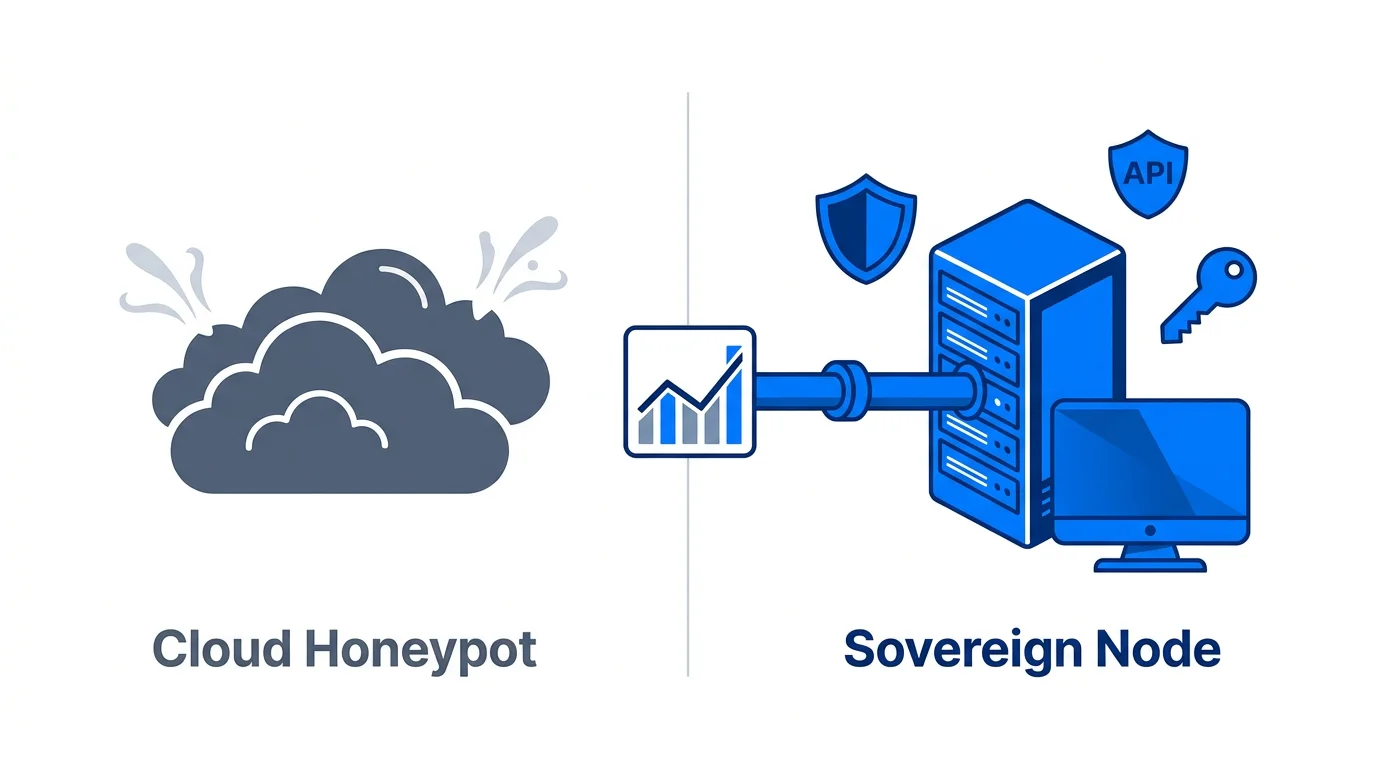
Cloud-first algorithmic trading is a trap. You spend months refining a strategy and backtesting thousands of parameters, only to hand your exchange API keys and proprietary logic to a multi-tenant SaaS provider. You trade full control for minor convenience, creating a centralized honeypot for attackers in the process.
When you execute financial logic on someone else's server, you forfeit data ownership and expose your architecture to third-party vulnerabilities. Real institutional trading firms do not deploy their core alpha on shared public cloud instances. They execute at the edge. A robust Local-First Trading Architecture guarantees strategy privacy, absolute data ownership, and dedicated compute cycles.
Running trading nodes on proprietary hardware requires a paradigm shift in how you build software. You have to account for physical hazards that cloud providers normally abstract away. The reliability calculus behind that shift is the same one we break down in full in our guide to choosing a Flutter local database in 2026. Whether the client writing to disk is a mobile app or a trading node, the durability guarantees don't change.
The Cloud Honeypot and the Risk of Delegated Execution
For nearly a decade, the standard software narrative pushed developers toward the cloud. SaaS trading bots and managed web environments offered low barriers to entry and zero hardware maintenance. As the ecosystem matures, the structural risks of this model are glaringly apparent.
When you use a cloud-based trading bot, you inject a massive point of failure into your security posture. Multi-tenant environments pool credentials from thousands of users into a single database. If the SaaS provider suffers an injection attack or a misconfigured AWS bucket, your hard-earned capital is entirely exposed. You are trusting a startup's internal security audits with your financial lifeblood.
Furthermore, cloud environments suffer from "noisy neighbor" syndrome. You share CPU cache and network bandwidth with other instances. When market volatility spikes and you need sub-millisecond execution times, a sudden CPU throttle on your shared instance can turn a profitable arbitrage opportunity into a severe loss.
Defensive Architecture: Anticipating Edge-Case Failures
Moving your infrastructure to a local Intel NUC, Mac Mini, or dedicated edge server gives you dedicated hardware, but it introduces distinct physical risks. You now face power outages, local database corruption, and disk exhaustion. A professional trading bot cannot simply crash and corrupt its state when the power cord gets bumped.
Building resilient, offline-first infrastructure from scratch is notoriously difficult. If you have ever tried to wire up complex state management, implement CRDTs (Conflict-free Replicated Data Types), or handle local-first data syncing, you know these are massive time-sinks. Development teams often burn entire engineering quarters just debugging database failovers.
This infrastructure overhead is exactly why we built Stacklyn Labs. Our premium, production-ready SaaS bundles and offline-first Flutter architectures allow agencies to bypass these exact backend headaches. Instead of spending months building local sync logic, you leverage our feature-first templates to start shipping actual business value on day one.
Hardening SQLite with Write-Ahead Logging (WAL)
To protect your local node from data corruption during a hard crash, you must implement strict database safeguards. SQLite is the standard for local-first persistence, but its default rollback journal configuration is completely unsuited for high-frequency algorithmic trading.
By default, standard SQLite locks the entire database when writing. If your bot attempts to read historical candle data while simultaneously recording a filled order, one operation blocks the other. The solution is enabling Write-Ahead Logging (WAL).
WAL mode changes the underlying mechanics of how SQLite handles disk I/O. Instead of overwriting the main database file directly, changes are appended to a separate -wal file. This allows simultaneous readers and writers, radically improving concurrency. More importantly, it ensures atomic writes; if the power cuts out mid-transaction, the main database remains entirely uncorrupted.
Python
# Python: Enabling SQLite WAL Mode for Reliable Edge Execution
import sqlite3

def init_db(db_path: str) -> sqlite3.Connection:
    conn = sqlite3.connect(db_path)

    # WAL mode enables concurrent reads/writes and hardens against corruption
    conn.execute('PRAGMA journal_mode=WAL;')

    # NORMAL synchronous mode balances safety with disk write performance
    conn.execute('PRAGMA synchronous=NORMAL;')

    # Increase cache size to keep recent operations in RAM
    conn.execute('PRAGMA cache_size=-64000;')

    return conn
The Silent Heartbeat: Monitoring the Edge
Because local hardware sits outside of managed AWS or GCP metrics, you need a mechanism to know if the machine goes dark. Relying on the bot to send failure emails is useless if the machine loses internet access entirely.
The standard architectural pattern here is a "Dead Man’s Switch" or a Remote Failover Heartbeat. The local node pings a lightweight, external server every sixty seconds. If the remote server stops receiving these pings, it triggers an SMS or Slack alert to your phone.
Python
# Implementing an isolated heartbeat to a remote monitoring service
import requests
import time

def send_heartbeat(status: str = "healthy"):
    try:
        # A timeout prevents the heartbeat from blocking the main trading thread
        requests.post(
            "https://monitor.yourdomain.com/ping",
            json={"id": "edge_node_01", "status": status},
            timeout=2.0
        )
    except Exception:
        # A silent fail ensures a temporary DNS error doesn't crash the bot
        pass
Performance Tuning: Shaving Milliseconds locally
On a local machine, you have dedicated access to the CPU and memory. You can optimize the runtime environment specifically for trading mathematics without fighting virtualization layers.
WebSockets Over REST Polling
A shocking number of retail trading bots still use standard HTTP REST calls to check asset prices. Polling a REST endpoint every few seconds requires the machine to establish a new TCP connection, complete a TLS handshake, and parse standard HTTP headers. This network overhead destroys execution speed.
To gain a real edge, your architecture must ingest WebSocket Streams. A WebSocket establishes a single, persistent TCP connection. Once the handshake completes, the exchange pushes raw ticker updates directly to your local node in real-time. Eliminating the constant HTTP overhead reduces your data lead-time from hundreds of milliseconds down to the sub-10ms range.
Python Memory Management with Slots
Algorithmic trading requires processing massive arrays of historical data. In Python, retaining months of Open-High-Low-Close-Volume (OHLCV) data in RAM can cause severe memory bloat. By default, Python creates a dynamic __dict__ for every instantiated object, allowing you to add arbitrary attributes at runtime. This flexibility comes with a massive RAM penalty.
When declaring your data structures, strictly use __slots__. This directive tells the Python interpreter to allocate a fixed amount of space for the object's properties, disabling the dynamic dictionary. This simple architectural tweak reduces your memory footprint by up to 60%, allowing your edge node to cache significantly more historical data for instant calculation without triggering system swap memory.
Building the trading engine is only half the project. Most funds and solo quants still need a public-facing site for the product or the fund itself, and hand-rolling that from scratch is a distraction from the strategy work. FinCore is a Bootstrap 5.3 landing page template built specifically for crypto exchanges and fintech startups, with a dark-mode aesthetic, a live-ticker UI, and glassmorphism cards already built in, so the front end isn't a second project.
The Sovereign Node Stack: Structuring for Production
A production-ready trading node needs a structured, resilient deployment layer to guarantee uptime; a raw Python script running in a terminal window isn't enough. Your Local-First Trading Architecture should mandate the following stack:
- Process Supervision: Your bot needs a watchdog. Relying on manual restarts is unprofessional. Use
systemd(on Linux environments) or Docker Compose restart policies. If the process encounters a fatal exception or the machine reboots after an OS update, the supervisor automatically brings the trading engine back online. - Encrypted Secrets Management: Never hardcode your exchange API keys directly in your repository. Store credentials in an encrypted
.envfile injected at runtime, or use a local instance of HashiCorp Vault. - Database Concurrency: As mentioned, utilize SQLite with WAL mode enforced. Configure your table indexes specifically for time-series lookups to prevent massive database sweeps during backtesting.
- Network Proximity: Physical distance matters. If you are trading heavily on Binance, spinning up your edge node in a Tokyo or Singapore local data center will vastly outperform a machine sitting in a basement in New York.
Testing and Deployment: The Containerized Edge
Testing financial software on your main solid-state drive degrades hardware rapidly. High-frequency backtesting involves millions of read/write operations.
To test locally without destroying your SSD, leverage an In-Memory SQLite Database. By passing ':memory:' as the connection string, SQLite builds the entire database schema directly in RAM. This allows your CI/CD pipelines and local unit tests to execute thousands of simulated trades in fractions of a second, entirely bypassing disk I/O bottlenecks.
Deploying with Docker Compose
When it is time to deploy, containerization is non-negotiable. Docker ensures that the environment your bot runs in remains perfectly consistent, regardless of whether you are executing on an M2 Mac or an Ubuntu Intel NUC.
By defining your volume mounts explicitly, you ensure that the database and configuration files persist safely on the host machine, while the application code remains isolated in the container. Setting network_mode: "host" removes the Docker bridge networking layer, guaranteeing absolute minimum latency for your WebSocket connections.
YAML
# Docker Compose: Local-First Trading Node
version: '3.8'
services:
  trading-bot:
    image: stacklyn/freqtrade-custom:latest
    restart: unless-stopped
    volumes:
      # Map local directories to persist data outside the container
      - ./user_data:/freqtrade/user_data
      - ./config.json:/freqtrade/config.json
    environment:
      - API_KEY=${EXCHANGE_API_KEY}
      - API_SECRET=${EXCHANGE_API_SECRET}
    # Bind directly to the host network interface to minimize latency
    network_mode: "host"
Reclaiming Strategy and Margin
Sovereign trading relies on reclaiming your technical margin and your privacy. Transitioning your architecture from managed cloud environments to the local edge eliminates centralized security risks and slashes recurring monthly overhead.
Building resilient local nodes demands disciplined engineering. You must account for hardware failures, handle your own memory management, and secure your execution environment. By mastering these foundational patterns, you ensure your trading logic remains exactly where it belongs: entirely in your hands.
References & Further Reading
- Algorithmic Trading Software: Freqtrade Open Source Documentation
- Database Resilience: SQLite Write-Ahead Logging (WAL) Architecture
- Infrastructure & Tooling: Explore Stacklyn Labs SubZero for secure subscription management and premium offline-first architectural templates.

Written by Stacklyn Labs
Stacklyn Labs is a small studio publishing offline-first Flutter templates on CodeCanyon and Codester since 2025, and building custom Flutter and web apps for the teams who buy them.