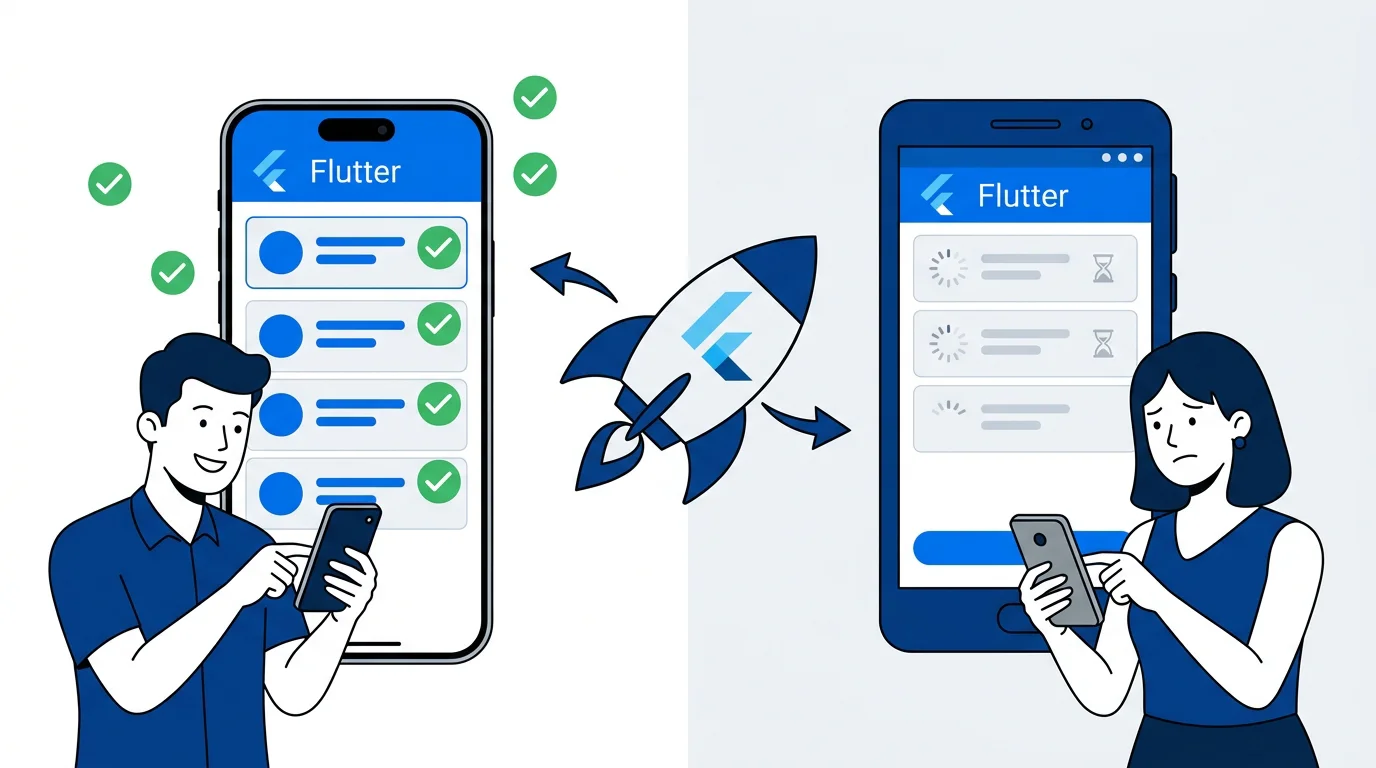
Enterprise software usually means bloated codebases, fragile database schemas, and agonizing deployment cycles. But you don't have to build monolithic dinosaurs anymore. The demand for cross-platform, highly performant internal tooling has forced a massive shift in how developers approach large-scale app architecture.
By combining the rendering power of Flutter with the backend agility of Supabase, developers can ship scalable platforms across iOS, Android, macOS, and the web from a single codebase. However, tools alone will not save a messy codebase. Building a Modular Flutter ERP Architecture requires strict boundaries, predictable state management, and an ironclad data layer.
Here is how you can build enterprise-grade software using Clean Architecture, Domain-Driven Design (DDD), and Riverpod without drowning in technical debt.
The Death of the Monolith
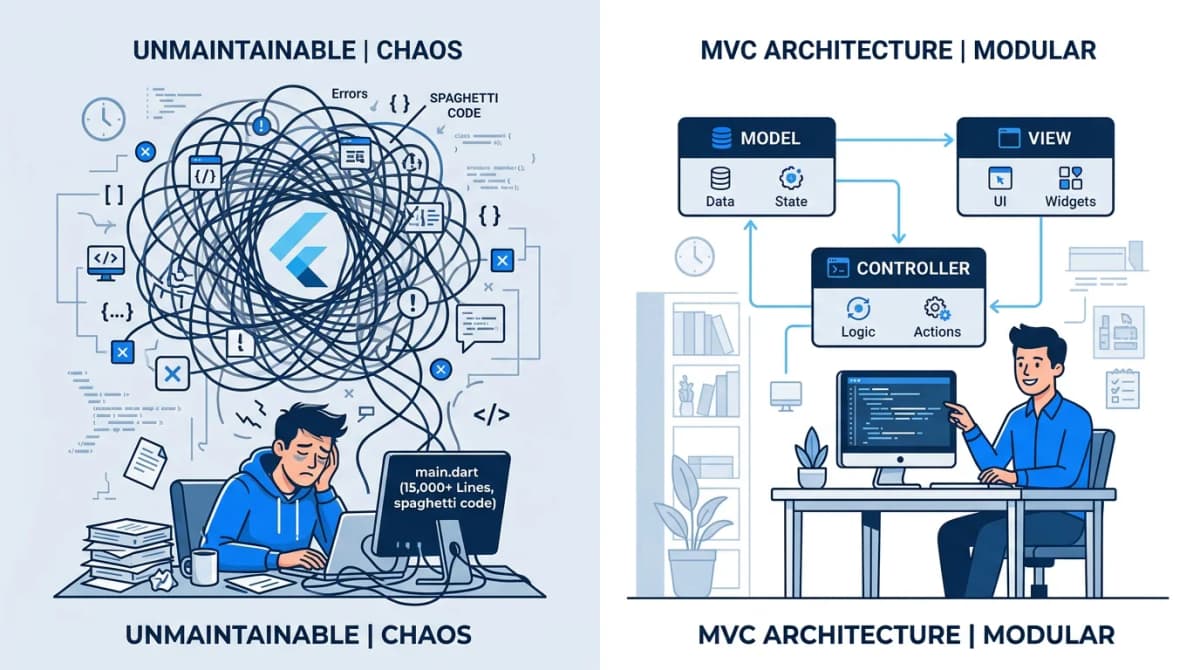
Legacy Enterprise Resource Planning (ERP) systems are infamous for their rigidity. A single change to an invoicing module often breaks the inventory dashboard. This tight coupling happens because developers historically built monolithic structures where the UI, business logic, and database queries lived in the same dense layers.
Modern development demands a reactive, modular approach. Businesses want updates pushed in days, not quarters. They expect applications to work offline, sync instantly, and run securely on any device. That starts with the on-device store, so it is worth settling which local database a Flutter app should use before the module boundaries are drawn.
Achieving this requires breaking the system down. You must isolate your business logic from your external dependencies. When you structure an application modularly, you can swap out an analytics package, change a database provider, or rewrite a UI widget without touching the core business rules.
Foundation: Clean Architecture and DDD in Flutter
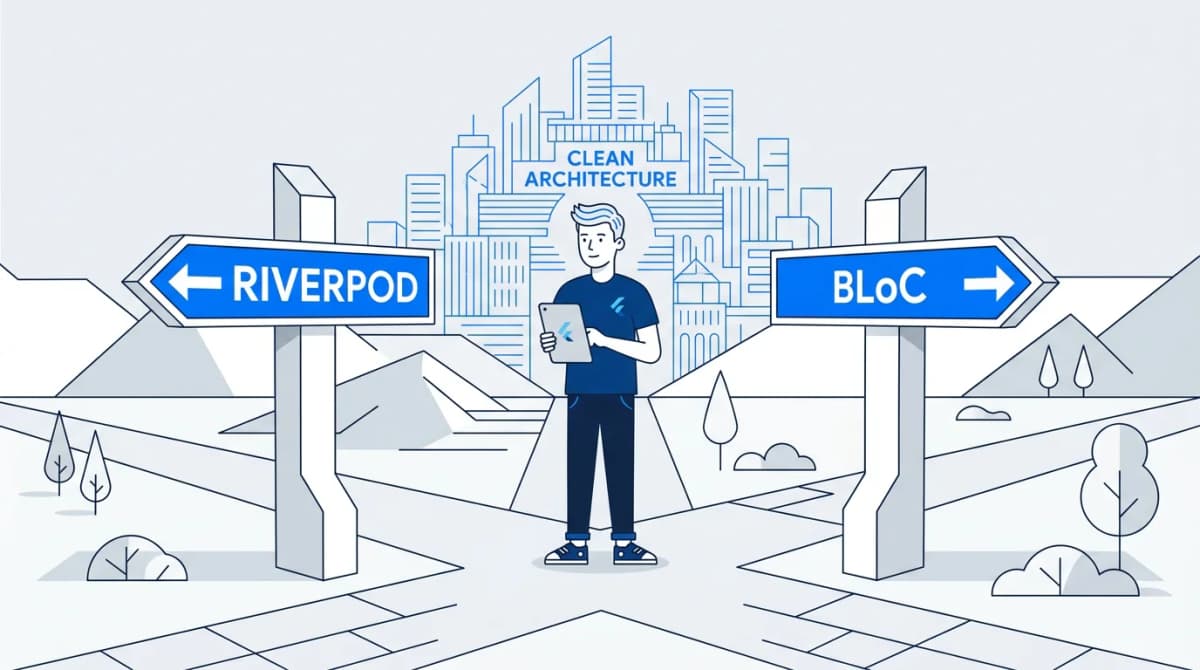
In any large application, complexity is your primary enemy. Clean Architecture neutralizes this threat by dividing your Flutter project into distinct, independent layers. The golden rule is the Dependency Rule: inner layers know nothing about outer layers.
1. The Domain Layer
This is the absolute core of your application. It contains your Entities (pure Dart objects), Value Objects, and Repository Interfaces. This layer operates in complete isolation. It imports no Flutter framework code, no Supabase packages, and no state management libraries. If your business rule dictates that an invoice cannot be approved without a manager's signature, that logic lives here.
2. The Data Layer
The Data layer acts as the bridge to the outside world. It implements the repository interfaces defined in the Domain layer. Here, you write the code that communicates with the Supabase API, handles local caching via SQLite or Hive, and parses JSON. You use Data Transfer Objects (DTOs) to map raw API responses into the pure Entities your Domain layer expects.
3. The Presentation Layer
This layer handles the Flutter UI and the state management logic. It reacts to changes in the Domain and Data layers, rendering the correct widgets. By keeping logic out of your UI, your widgets remain "dumb" and highly testable.
Structuring Bounded Contexts
Applying Domain-Driven Design (DDD) takes this a step further by breaking the ERP into distinct Bounded Contexts. Instead of one massive lib folder, you structure your app by feature.
Your Inventory Management module and your Human Resources module function as independent micro-apps within the codebase. They maintain their own Domain, Data, and Presentation layers. If the HR module needs to know about an employee's equipment from the Inventory module, they communicate through strictly defined interfaces, never by reaching directly into each other's databases. This prevents the spaghetti code that plagues legacy ERPs.
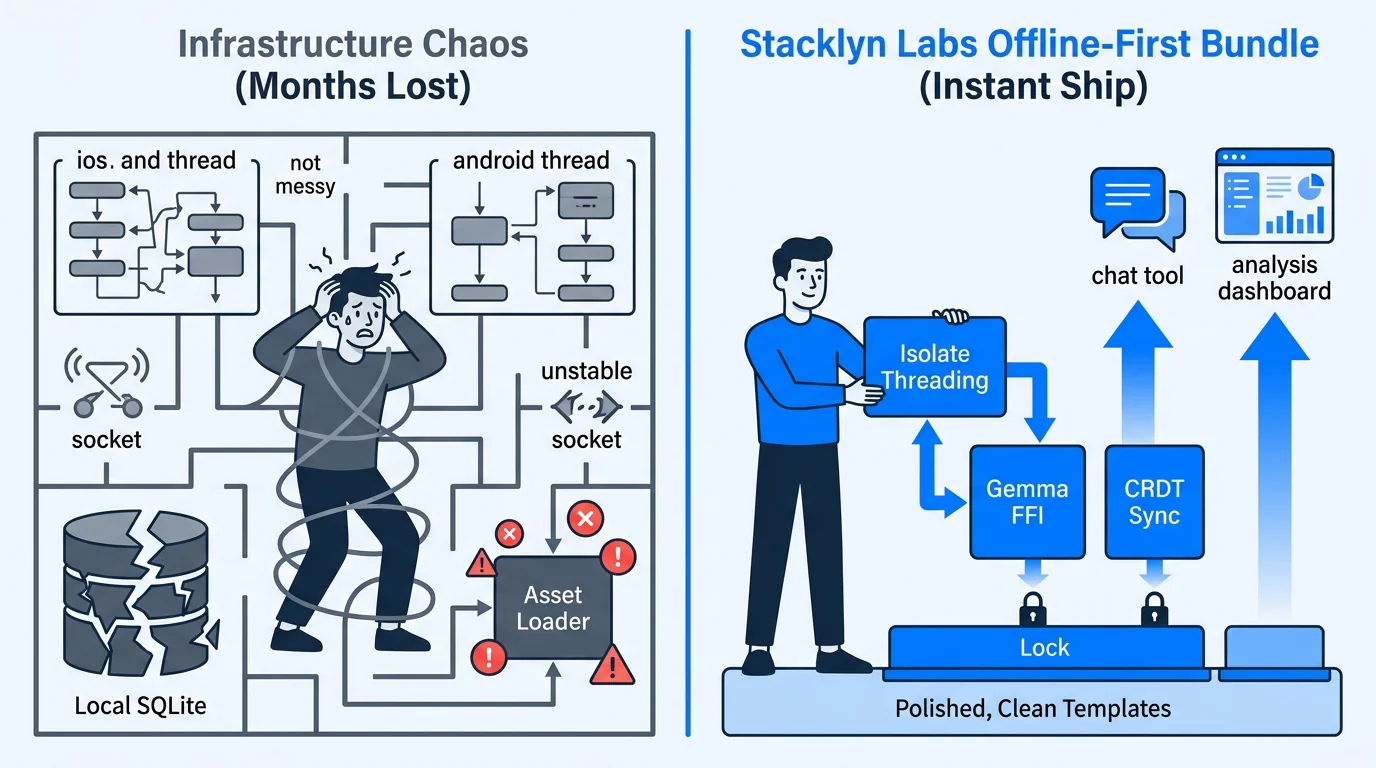
The Agency Time-Sink: Architecting these boundaries, writing abstract classes, and setting up repository patterns from scratch takes weeks of boilerplate work. State management plumbing and local-first syncing are massive time-sinks for development teams trying to hit tight deadlines.
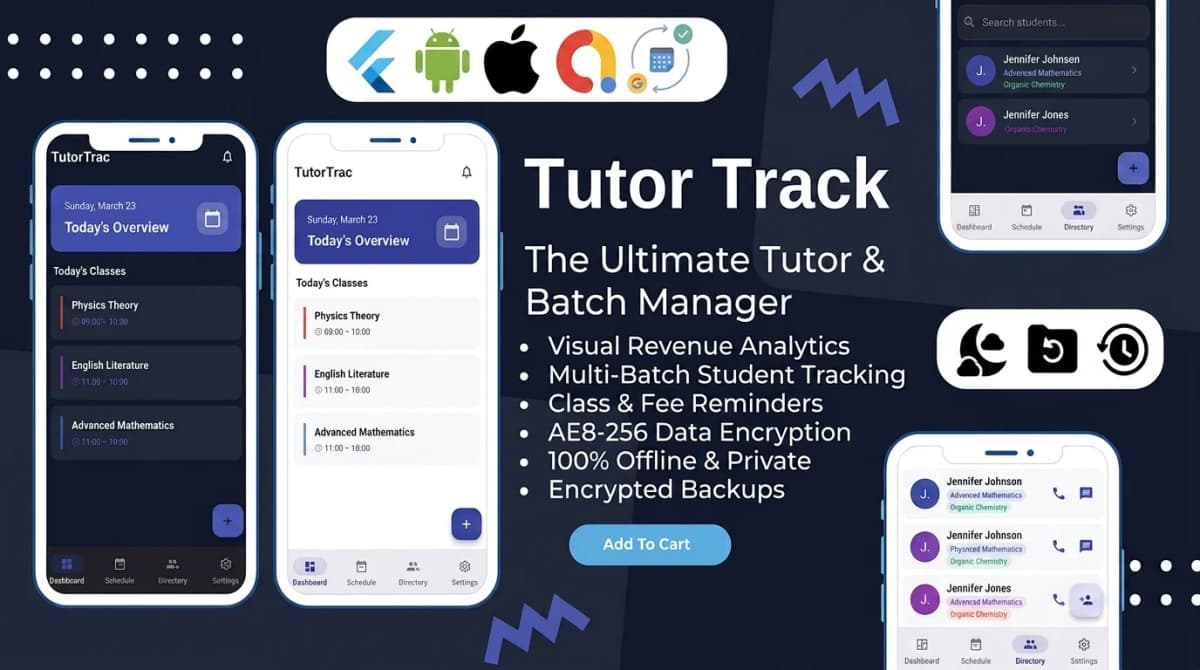
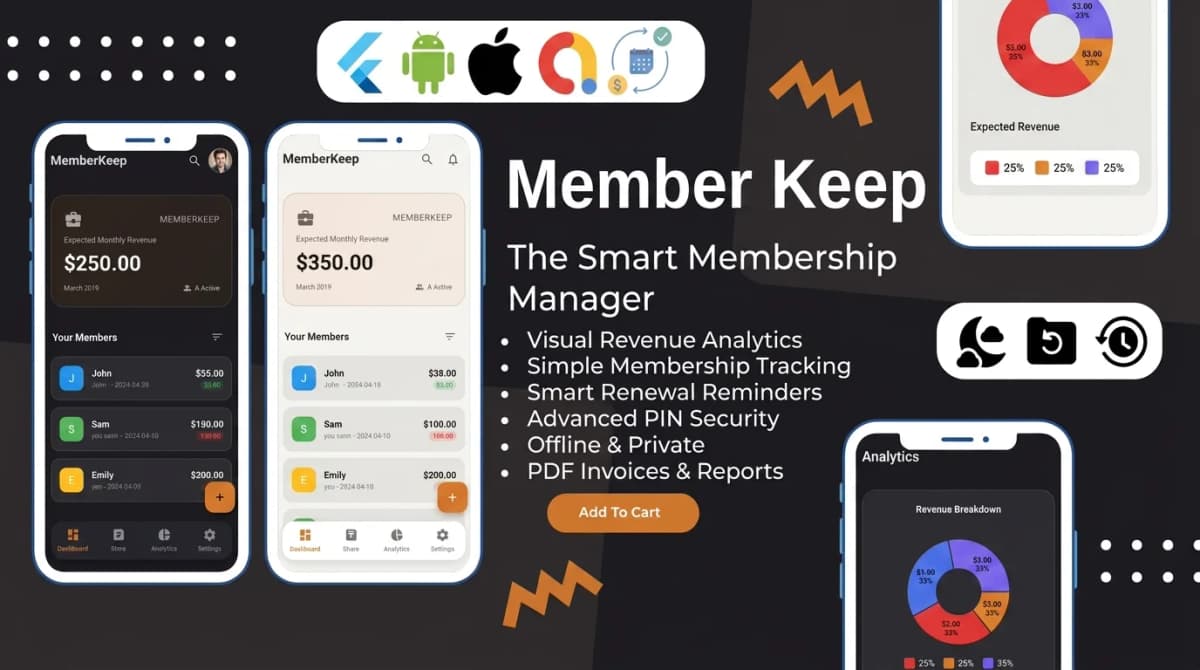
Agencies that utilize production-ready, feature-first templates like the SaaS-in-a-Box bundles we build at Stacklyn Labs bypass these infrastructure headaches entirely. Starting with a pre-configured offline-first architecture allows you to ship months faster, focusing on actual client features instead of fighting dependency inversion.
Mastering State: Riverpod for Enterprise Apps
Managing state across hundreds of complex screens requires a bulletproof strategy. Riverpod is the current gold standard for state management in Flutter. It provides compile-time safety and completely removes the need to pass BuildContext around your logic classes.
For a modular ERP, Riverpod's modern asynchronous classes are non-negotiable tools.
Reactive Streams and AsyncNotifier
Enterprise dashboards require real-time data. You need to reflect database changes immediately without forcing the user to manually refresh. Riverpod’s AsyncNotifier and StreamProvider handle this natively.
When you bind a StreamProvider to a Supabase real-time channel, your Flutter UI updates instantly as rows change in your Postgres database. Riverpod handles the loading, error, and data states automatically. You stop writing repetitive try-catch blocks and isLoading booleans, and instead rely on the .when() method to render your UI predictably.
Clean Dependency Injection
Riverpod doubles as a robust dependency injection (DI) framework. You can define your external clients (like the Supabase instance) in a global provider. Then, you inject that client into your Data Repositories, and subsequently inject those repositories into your Use Cases.
This creates a clean, traceable flow of data. If a network request fails, you know exactly which provider threw the error, making debugging significantly faster.
Testing the Modular ERP
Testing complex state is where legacy apps fall apart. Because Riverpod providers are declared globally but instanced locally within the ProviderScope, testing becomes highly pragmatic.
During unit and widget testing, you can use .overrideWithValue() to swap out a live production repository for a mock repository. You can simulate delayed network responses, force API errors, and verify that your UI responds correctly, all without ever hitting a real database.
The Supabase Backbone: Security and Scale
Supabase operates as the ideal backend for a Flutter-based ERP. It gives you a dedicated PostgreSQL database, authentication, and file storage out of the box. Postgres is the undisputed heavyweight champion of relational databases, offering the strict schema design required for financial and enterprise data.
Row Level Security (RLS)
In an enterprise environment, security cannot be an afterthought handled by the frontend. Row Level Security (RLS) pushes authorization directly down to the database engine.
With RLS, you write SQL policies that dictate exactly who can read, insert, or update a specific row. You can configure a policy ensuring a regional sales rep only sees leads assigned to their specific territory, while a global admin can query the entire organization's pipeline. Even if a bad actor bypasses your Flutter client and hits the Supabase API directly, the database drops the request. The security is mathematical and absolute.
PostgREST and Boilerplate Reduction
Supabase utilizes PostgREST, a tool that automatically inspects your database schema and generates a secure, RESTful API. You do not need to write intermediate backend controllers or CRUD endpoints in Node.js or Python.
When you add a new table for employee_benefits, your Flutter app can immediately query it using the Supabase Dart SDK. This eliminates an entire layer of backend maintenance, allowing small teams to output the work of much larger engineering departments.
Edge Functions for Heavy Lifting
Mobile devices should not process massive computational tasks. When an ERP needs to generate a 50-page PDF invoice, process a batch payroll script, or connect to a third-party payment gateway like Stripe, you offload that work.
Supabase Edge Functions allow you to write TypeScript functions deployed globally to the edge. Your Flutter app simply triggers the function, passes the necessary parameters, and waits for the result. This keeps your client app lightweight and ensures sensitive API keys never ship inside your mobile binaries.
Economics of the Modern Stack
The shift toward Flutter and Supabase is actively changing the economics of custom software. Historically, Small and Medium Enterprises (SMEs) faced a brutal choice. They could either pay extortionate licensing fees for bloated off-the-shelf software, or they could spend hundreds of thousands of dollars building a custom web stack over several years.
This modern architectural approach drastically reduces "Time to Market".
By leveraging Bounded Contexts, development teams can build a targeted Minimum Viable Product (MVP). You might start by shipping just the CRM module to get the client up and running. Because the architecture is modular, you can safely bolt on the Accounting and Logistics modules six months later without rewriting the core application.
This Lego-like construction process drops development costs by up to 40% compared to traditional React/Node or native iOS/Android builds. Furthermore, solving complex enterprise requirements like offline data syncing with Conflict-Free Replicated Data Types (CRDTs) is no longer a roadblock. By leveraging pre-built architectural templates from studios like Stacklyn Labs, agencies can deliver offline-first functionality in a fraction of the time, dramatically increasing their profit margins.
Offline storage, stock tracking and a clean module layout are the expensive parts of any inventory-style module. If you want to see that done before committing to your own build, StockPilot is an offline-first Flutter POS and inventory app that keeps its data on the device with Hive and ships a cleanly structured codebase.
Building for the Future
Architecting an ERP with Flutter, Riverpod, and Supabase is the new baseline for high-performance enterprise tools, not a passing trend. By strictly enforcing Clean Architecture, you protect your business logic. By utilizing Riverpod, you guarantee predictable state. By relying on Postgres and RLS, you secure your data at the lowest possible level.
As Flutter's support for WebAssembly (Wasm) and native desktop environments continues to mature, this tech stack will only become more dominant. Developers who master these modular patterns today will be the ones shipping the most resilient, scalable software tomorrow.
References & Further Reading
- Flutter Architecture: Flutter Documentation: Performance and UI Architecture
- Backend & Security: Supabase Documentation: Securing your Data with RLS
- State Management: Riverpod: Reactive State Management Fundamentals
- Software Design: The Clean Architecture by Robert C. Martin (Industry Standard text on dependency inversion and boundary isolation).

Written by Stacklyn Labs
Stacklyn Labs is a small studio publishing offline-first Flutter templates on CodeCanyon and Codester since 2025, and building custom Flutter and web apps for the teams who buy them.