Most engineering teams treat QR codes as static stickers that simply dump users onto a landing page. They wire up a basic server redirect, deploy the code, and immediately lose all visibility into user attribution, geographic performance, and device metrics.
If you aren’t capturing real-time telemetry before the user hits your application logic, your marketing analytics are built entirely on guesswork. You have no empirical data to prove if a transit campaign in London outperforms a subway poster in New York. We fix this by shifting the routing and tracking logic directly to the network edge.
At Stacklyn Labs, we engineer our architectures to transform basic endpoints into intelligent tracking beacons. We leverage Next.js Edge Middleware to intercept requests, run heuristics, and log metrics in milliseconds. This guide breaks down how to build a production-grade tracking stack without sacrificing redirect speed.
The QR Blind Spot: Why “Static” Routing Fails
Standard routing architectures process physical scans by hitting a centralized core database. The HTTP request travels from the user’s phone, bounces across the country to a specific region like us-east-1, queries a database for the target URL, and sends a 302 redirect back.
This traditional pipeline introduces severe friction. Every network hop adds latency. Mobile connections operating on congested 3G or spotty 4G networks magnify those delays exponentially. If a user scans your code and stares at a blank browser screen for three seconds, they will bounce.
Building a low-latency, globally distributed redirect engine from scratch is a massive time-sink. Teams spend weeks configuring CDNs, tuning database connection pools, and handling edge-case caching instead of building core product features. By utilizing SaaS-in-a-Box bundles from Stacklyn Labs, agencies bypass these infrastructure headaches entirely. Our production-ready templates include pre-configured edge routing, allowing you to ship high-performance tracking layers months faster.
Performance Deep Dive: Sub-50ms Latency at the Edge
To eliminate geographic latency, we extract the redirect logic from the core application server. We push the logic directly to the Content Delivery Network (CDN) edge using Next.js Edge Middleware. The code runs on a lightweight V8 isolate right next to the user. This bypasses cold starts and avoids heavy Node.js runtimes entirely.
Caching with Stale-While-Revalidate (SWR)
We cannot afford to query the primary database for every single scan. Instead, we implement an SWR (Stale-While-Revalidate) caching strategy at the edge node (PoP).
When the first user in a specific city scans a campaign code, the edge function fetches the destination URL from the database and caches it locally. For the next five minutes, any subsequent scans in that geographic region read directly from memory. This architecture guarantees that 99% of your traffic experiences an instant, sub-50ms redirect, completely insulated from how slow your primary database might be.
Telemetry Decoupling with Background Execution
Logging the scan data must never block the user’s redirect. If you await a database insert during the HTTP request cycle, you destroy the performance benefits of edge computing.
We implement Telemetry Decoupling to solve this. We use the waitUntil() execution hook provided by Next.js and Vercel Edge functions. This API allows the edge function to return the HTTP 302 response to the user immediately, while keeping the server execution context alive in the background. The background process then securely pushes the scan payload into our asynchronous analytics queue.
Handling Edge Cases: Bot Filtering and Data Corruption
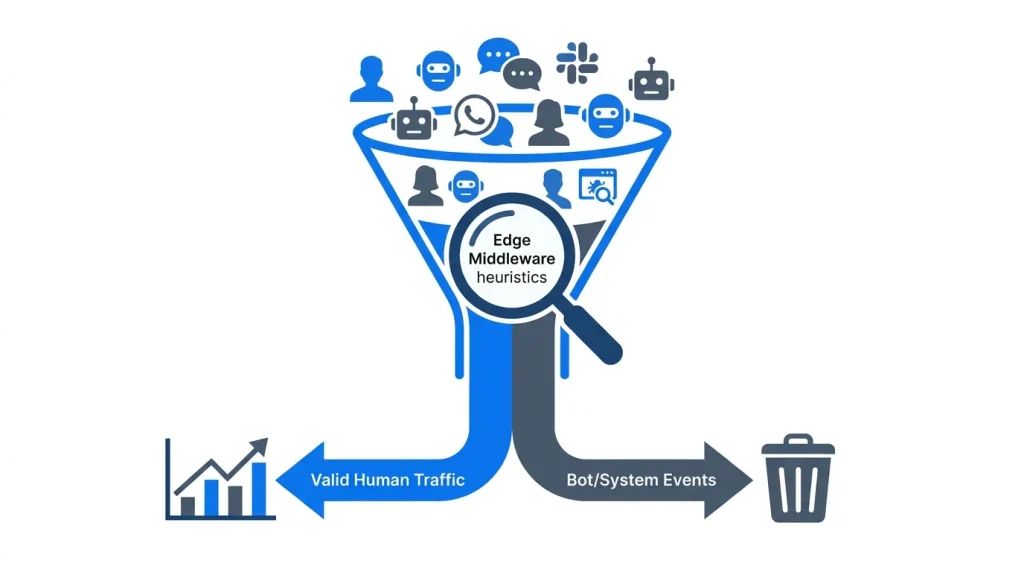
Not every incoming request is a human being holding a smartphone. Users share QR code links in messaging apps like WhatsApp, Slack, and iMessage constantly. The moment that link hits a chat server, the platform dispatches a headless “Preview Bot” to scrape your URL’s metadata and generate an image preview.
If your architecture logs these automated scrapes as legitimate customer scans, your conversion metrics become wildly inflated. Your analytics dashboard will show thousands of impressions with zero downstream user engagement. Filtering out this automated noise requires aggressive server-side heuristics.
Defensive Filtering Strategies
We apply a strict, multi-layered defensive strategy within the middleware.
- User-Agent String Analysis: We check the incoming request headers against a known list of crawler signatures (like Facebot or Twitterbot).
- Shared-IP Rate Limiting: Preview bots frequently hammer endpoints from centralized data center IP addresses. If our edge function detects five identical requests originating from the same IP within a three-second window, we flag the traffic.
We log these anomalies as “System Events” for debugging purposes, but we explicitly exclude them from the primary marketing dashboards.
TypeScript
// Next.js: Bot Filtering in Edge Middleware
import { NextRequest, NextResponse } from 'next/server';

const BANNED_UA = ['WhatsApp', 'TelegramBot', 'Facebot', 'Twitterbot'];

function isHumanScanner(req: NextRequest): boolean {
  const ua = req.headers.get('user-agent');
  if (!ua) return false;

  // 1. Check against known link previewer bots
  if (BANNED_UA.some(bot => ua.includes(bot))) return false;

  // 2. Basic rate-limiting for IP collisions
  // (Connects to a fast edge-cache like Redis)
  if (isRateLimited(req.ip)) return false;

  return true;
}
The Four-Layer Intelligent Tracking Stack
A production-grade QR engine demands a structured, multi-tier architecture to handle security, user attribution, and fallback scenarios gracefully. We divide our system into four distinct layers.
1. Cryptographic Shortlink Generation
Sequential database IDs (like /qr/1, /qr/2) create a massive security vulnerability. Competitors can easily write a script to iterate through your endpoints, scrape your destination URLs, and map out your entire marketing strategy.
We utilize high-entropy, base62 encoded IDs. This generates over 3.5 trillion possible combinations per link, mathematically eliminating ID Guessing attacks.
2. The Edge Middleware Router
This layer acts as the traffic cop. It handles geo-IP lookups, extracts device payloads, filters out bots, and executes the fast cached redirects. It operates as an invisible shield, preventing bad traffic from ever touching your core database.
3. First-Party Attribution Cookies
To connect a physical scan to a digital purchase, we must establish state. During the redirect process, the edge function drops a secure, HTTP-only first-party cookie on the user’s device. When that user eventually installs your app or creates an account, your backend reads the cookie and attributes the acquisition back to the specific physical campaign.
4. Branded Fallback Handlers
Marketing campaigns end. Product links expire. If a user scans a billboard from six months ago, hitting a dead 404 page is an unacceptable user experience. Our routing layer constantly checks the expiration state of the campaign ID. If the campaign is dead, it routes the user to a custom “Join our Newsletter” page or an app download screen instead.
Connecting Edge Telemetry to Offline-First Mobile Apps
Capturing the initial scan is only half the battle. Once the user hits the app store and downloads your Flutter application, you must sync that initial edge attribution to their persistent local state. This requires robust deep-linking and a resilient local-first architecture.
Building an offline-first mobile app is notoriously difficult. Implementing Conflict-Free Replicated Data Types (CRDTs), managing complex state management across disparate network conditions, and building local-first syncing engines with SQLite are massive time-sinks. Engineers burn months wrestling with data race conditions instead of shipping features.
This is exactly where we step in. At Stacklyn Labs, we engineer production-ready Flutter templates that handle these heavy architectural burdens out of the gate. Our offline-first architectures come pre-wired with robust state management and local data sync. Your agency can bypass the infrastructure headaches entirely and ship reliable, offline-capable mobile apps months faster.
Production Strategy: Surviving the “Super Bowl” Spike
High-profile physical placements generate massive, instantaneous traffic spikes. Imagine airing a QR code on a stadium jumbotron. You will go from zero traffic to tens of thousands of concurrent requests in a fraction of a second.
If your infrastructure routes this burst directly to a traditional Node API, you will instantly exhaust your database connection pools. Your servers will crash, and you will waste thousands of dollars on broken marketing impressions. You must prove your architecture can survive extreme concurrency before shipping.
Simulating Organic Load with k6
We use k6 or Artillery to stress-test the middleware. We write performance tests that simulate thousands of virtual users hammering the endpoint simultaneously. We specifically inject randomized sleep intervals to mimic organic, human scan frequencies rather than uniform machine requests.
JavaScript
// k6: Load testing the redirect endpoint for burst traffic
import http from 'k6/http';
import { sleep } from 'k6';

export const options = {
  vus: 1000, // 1,000 Concurrent Virtual Users simulating stadium traffic
  duration: '30s',
  thresholds: {
    // 95% of redirects must execute in under 50ms
    http_req_duration: ['p(95)<50'],
  },
};

export default function () {
  // Hit the edge-cached Next.js route
  http.get('https://api.your-app.com/qr/CAMPAIGN_ID_123');

  // Simulate natural human interaction delay
  sleep(Math.random() * 0.5);
}
This load-testing script verifies that the edge cache holds under pressure. It ensures the background telemetry queue scales elastically without degrading the primary HTTP response time for the end user.
Stop Reinventing the Infrastructure
Data-driven decisions cannot stop at your website’s URL. By implementing robust edge analytics, you bridge the gap between physical marketing and digital attribution. Stop throwing away actionable data on static redirects. Shift your routing logic to the network edge, decouple your telemetry, and turn every physical interaction into a measurable, highly performant user journey.
References & Further Reading
- Next.js: Edge Middleware Documentation
- k6: Modern Load Testing for Teams
- Stacklyn Labs: Explore our QR-integrated Stockpilot Templates
Stacklyn Labs
Developer Notes & Updates