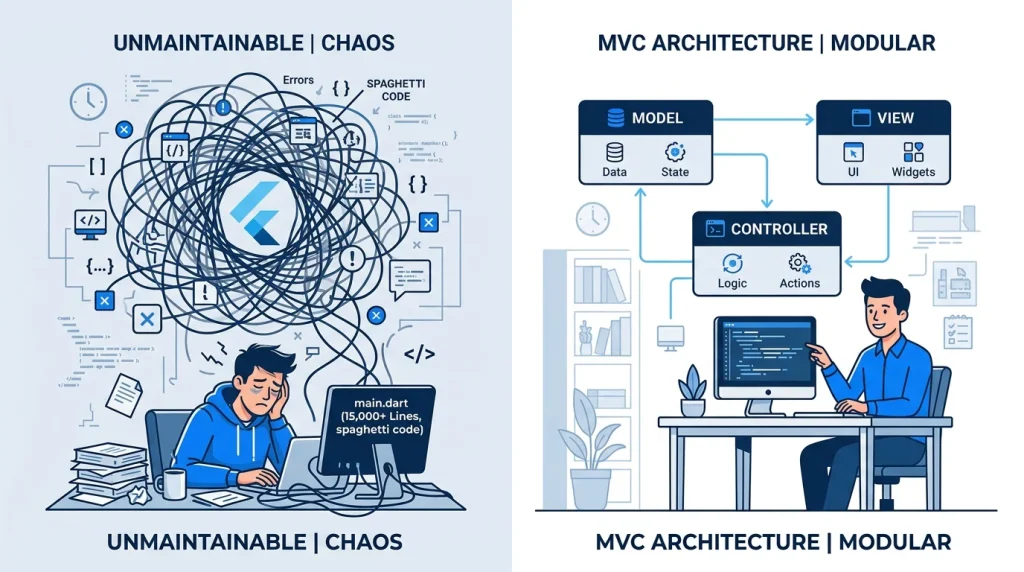
Have you ever opened a Flutter project after a few months away, only to stare blankly at a single file that spans 2,000 lines of code? If you’ve been there, you already know the pain. Flutter is incredibly flexible, which is part of its magic. But that same flexibility can let you quietly mix your UI, business logic, and API calls until your app becomes a tangled web of spaghetti code.
If you’re building a quick weekend prototype, you can get away with it. But if you’re aiming to build truly scalable Flutter apps, you need a rock-solid foundation from day one. Today, we’re diving into the world of clean code architecture flutter style. We’ll explore how implementing a strict MVC (Model-View-Controller) pattern saves your sanity, why strongly typed models are non-negotiable, and how purchasing highly organized source code is the ultimate cheat code for avoiding severe technical debt. Let’s get into it.
The Trap of the “God Widget”
When you first start learning Flutter, it’s tempting to do everything inside a single Stateful Widget. You fetch network data in the initState, process business rules locally, and render the entire UI in the build method. It feels fast, and you see visual results immediately on your emulator.
But as your application grows, this approach turns into a development nightmare. We call these bloated files “God Widgets” widgets that simply know and do way too much. When your UI and core business logic are fused together, writing unit tests becomes practically impossible. If you need to swap out a backend API, you risk breaking the entire visual interface of the app.
This is exactly why architectural principles matter. Clean architecture draws strict boundaries in your codebase. It forces a clear separation between what your app actually does (the business logic) and how it is displayed to the user (the presentation). By organizing code by responsibility rather than piling everything into UI files, your app remains stable, testable, and genuinely easy to scale as you add new features.
Decoding the Flutter MVC Pattern
So, how do we draw those critical boundaries? One of the most effective approaches is the Flutter MVC pattern. While there are many architectural choices floating around the community (like MVVM or heavy multi-layered Clean Architecture setups), MVC remains a beautifully simple and highly effective way to enforce the separation of concerns.
Let’s break down the three pillars of this approach:
1. The Model (Data and Logic)
This is the heart of your data. The model layer represents your business entities, API responses, and application state. It doesn’t know anything about the UI, what widgets are being used, or how the user interacts with the app. It just holds the cold, hard facts.
2. The View (The Presentation)
This is what the user actually sees. In Flutter, the view is purely your widget tree. The golden rule here is to keep the UI as “dumb” as possible. A view shouldn’t calculate tax rates, validate complex forms, or fetch database records. It should only display formatted data and listen for user interactions like button taps.
3. The Controller (The Brains)
This is the middleman that coordinates everything. When a user clicks a button in the View, the View doesn’t handle the action itself; it simply tells the Controller. The Controller then processes that request, talks to the Model to update the data, and tells the View to refresh with the new information.
A Structural Blueprint for Your Flutter Project Structure
A great architectural concept is only as good as the folder structure that physically supports it. If you want to build scalable apps, you need a flutter project structure that any developer can navigate intuitively on their first day.
While there is no single “perfect” way to organize a project, a feature-first approach combined with MVC layers works wonders for growing applications. Instead of grouping all your controllers in one massive folder and all your views in another, you group them by the actual features of the app.
Here’s a blueprint of what a highly scalable project looks like:
Plaintext
lib/
├── core/
│   ├── network/       # API clients, HTTP interceptors
│   ├── theme/         # App-wide colors, typography
│   └── widgets/       # Reusable UI components
└── features/
    ├── authentication/
    │   ├── models/        # User data, auth tokens
    │   ├── views/         # Login screen, register screen
    │   └── controllers/   # Login logic, session management
    └── dashboard/
        ├── models/        # Dashboard analytics data
        ├── views/         # Main dashboard layout
        └── controllers/   # Data fetching and state management
As your app scales, you won’t have to hunt across the entire codebase to fix a bug in the login flow. Everything related to authentication lives in one predictable, isolated place. This modularity is an absolute lifesaver for team collaboration and long-term maintenance.
Strongly Typed Models: Your App’s First Line of Defense
Let’s zoom in on the “Model” part of our architecture. When pulling data from a REST API, it’s incredibly tempting to just parse the JSON response into dynamic Dart maps and move on. But in a large-scale application, relying on dynamic types is like walking a tightrope without a safety net.
Strongly typed models act as your app’s first and most critical line of defense. By strictly defining the shape of your data knowing exactly whether a user ID is an integer or a string you catch fatal errors at compile-time rather than runtime.
With modern Dart SDK releases (like the stable 3.11.1), developers have fantastic tools for robust type safety and pattern matching. When you use strongly typed models, you get the immense benefit of auto-completion in your IDE, which drastically speeds up daily coding. More importantly, if a backend API response changes unexpectedly, your app fails safely during development rather than crashing mysteriously for your users. It’s an absolute necessity for enterprise-level architecture.
Escaping Technical Debt with High-Quality Source Code
Even if you deeply understand MVC and clean architecture, building a robust, production-ready foundation from scratch is incredibly time-consuming. Developers often spend weeks wrestling with folder structures, state management boilerplates, and API interceptors before they even begin building the actual features users care about.
This is where the “build vs. buy” decision becomes a crucial advantage. Purchasing highly organized, premium source code like a professionally crafted Flutter template isn’t just about getting a pretty user interface. It’s about buying an architectural head start.
When you leverage top-tier source code, you instantly adopt industry best practices. You skip the painful trial-and-error phase of figuring out project structures. You get strongly typed models, strict separation of business logic from the UI, and scalable navigation routing right out of the box.
Most importantly, starting with a clean template prevents severe technical debt. You aren’t hacking things together just to meet a deadline; you are building on a foundation designed to scale from day one.
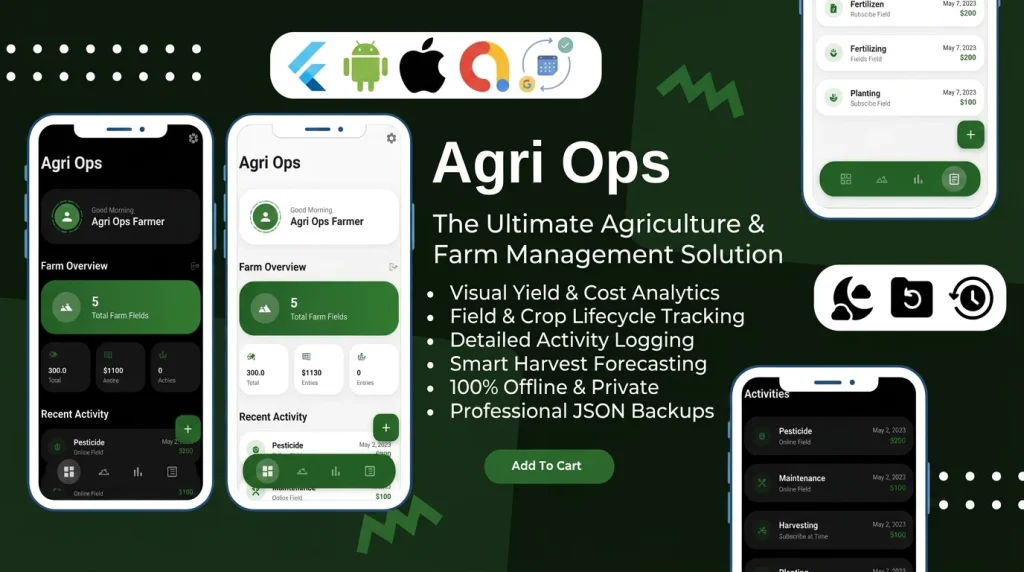
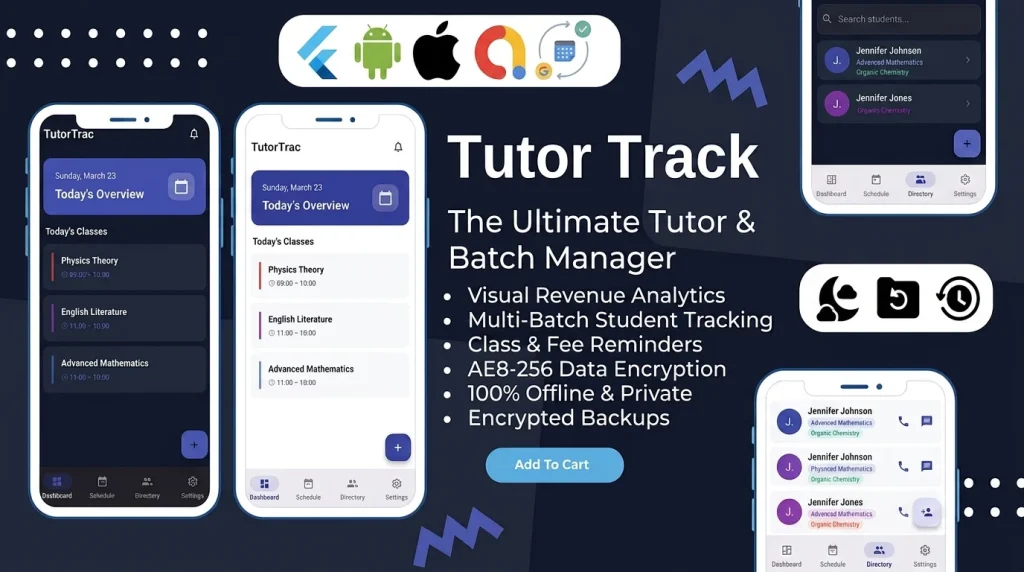
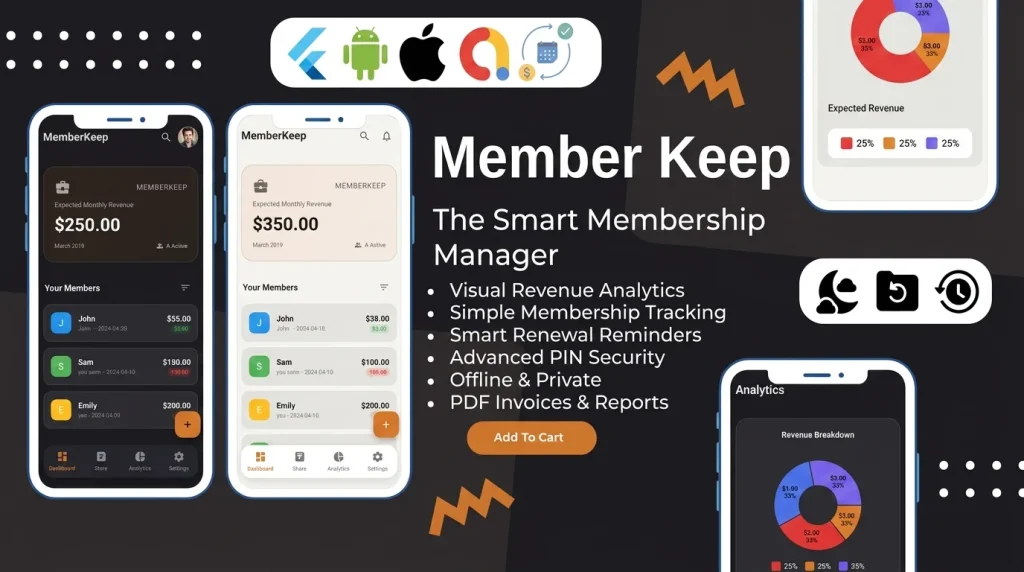
At Stacklyn Labs, we understand this deeply. Our app templates aren’t just nice-looking UI widgets thrown together. They are meticulously engineered blueprints. Whether you use our Zenith, StockPilot, SubZero, or Rent Folio templates, you can rest assured they are built on strict, modern architectural patterns. Your codebase will scale right alongside your business, without missing a single beat.
Conclusion
Writing clean code in Flutter isn’t about blindly following rules; it’s about setting yourself up for long-term success. By embracing the MVC pattern, structuring your project logically by feature, utilizing strongly typed models, and keeping your UI separate from business logic, you build applications that are a joy to maintain and incredibly easy to scale.
Don’t let crippling technical debt slow down your next big idea. If you want to accelerate your development timeline without compromising on code quality, explore the highly architected Flutter templates at Stacklyn Labs. Start your next big project on a foundation that’s actually built for scale.
Further Reading & References
- “The Clean Architecture” by Robert C. Martin (Uncle Bob)The foundational 2012 article that established the modern rules for separating business logic from presentation layers. A must-read for understanding why we isolate our models and controllers.
- Flutter Architectural OverviewThe official documentation from the Flutter team detailing how the framework handles the widget tree, state, and rendering. It provides great context on why keeping the “View” layer lightweight is so important.
- “Flutter Project Structure: Feature-first or Layer-first?” by Code with AndreaAn excellent, in-depth community resource by Andrea Bizzotto that expands on the feature-first folder structure outlined in this post, complete with real-world scaling examples.
- The Dart Type SystemThe official Dart language guide on sound typing and null safety. This backs up the importance of using strongly typed models to catch errors at compile-time instead of runtime.
- “GUI Architectures” by Martin FowlerA deep dive by software engineering pioneer Martin Fowler into how presentation patterns like MVC actually work under the hood, and how controllers effectively bridge the gap between user actions and data models.
Stacklyn Labs
Developer Notes & Updates